
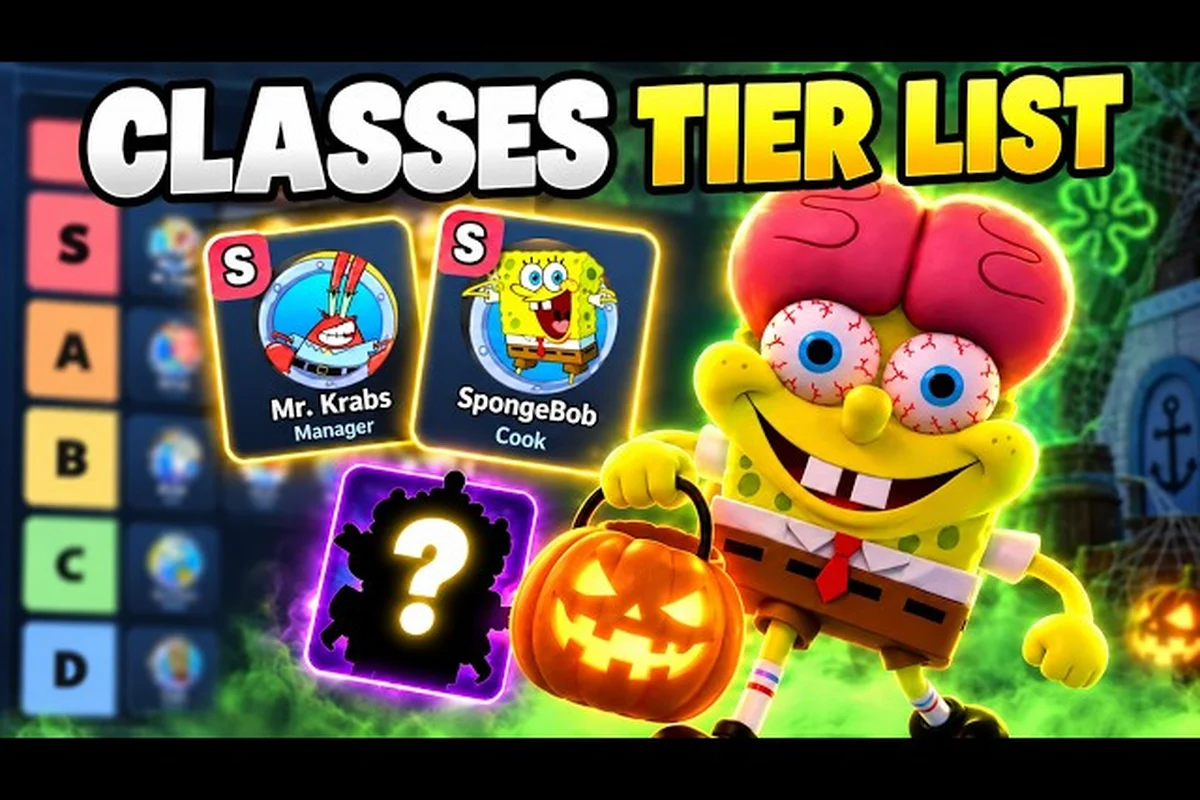
Choosing a class in Save the Krusty Krab changes how efficiently you handle cooking, orders, tables, and emergencies. This all classes list explains every character’s practical strengths, useful abilities, and best role so you can build a balanced restaurant crew.
All classes list and role overview
The Save the Krusty Krab all classes list contains ten playable characters, but their value depends on the job assigned to them. A strong cook is not automatically the best solo choice, while support abilities can make a more dependable teammate preferable to a flashy specialist.
The roster includes SpongeBob, Mr. Krabs, Patrick, Squidward, Sandy, Gary, Fred, and other playable options. Based on community field notes, SpongeBob can prepare two patties simultaneously with automatic flipping, increasing to three at level 2 and four at level 3. His grill improvement also benefits the crew grill rather than only the individual player.
| Class | Primary Strength | Best Assignment | Key Ability Summary |
|---|---|---|---|
| SpongeBob | High-volume cooking | Grill | Cooks more patties and flips automatically |
| Mr. Krabs | Restaurant management | Register or floating support | Adds tables and improves the crew’s end-of-day cash |
| Patrick | Simple customer service | Order delivery or tables | Straightforward handling with a dependable early-game kit |
| Squidward | Order management | Register | Improves the flow of incoming customer requests |
| Sandy | Versatile assistance | Multiple stations | Adapts well when the crew needs flexibility |
| Gary | Emergency support | Support or special tasks | Shortens a shake-machine cooldown and carries a magic conch |
| Fred | Beginner-friendly service | Orders or tables | An accessible option for learning restaurant routines |
| Other crew members | Specialized tasks | Situational roles | Their value depends on station coverage and crew needs |
This overview is best treated as a role-based reference, not a promise that one character wins every situation. Exact unlock order, prices, and progression can affect which choices are available, so the class prices and unlock details can help clarify what you can use at the start.
What makes a top-tier class?
A top-tier class combines reliable output, manageable station demands, and a passive effect that supports the whole restaurant. The strongest option in a two-person crew may differ from the best choice in a four-person group, especially when multiple people can cover the same station.
Community observations provide several useful benchmarks. Jim cooks patties 25 percent faster and begins with three kelp shakes. Mr. Krabs adds one starting table at level 1 and two at level 2, while his crew receives a 10 percent end-of-day cash bonus. Gary reduces the kelp shake machine cooldown by 25 percent and can revive a teammate with a magic conch.
Treat those figures as community-reported values, because the developer has not published a complete numerical balance sheet. Reported patty capacity, starting cash, and passive percentages can change with updates, so avoid building a strategy around a value that your current version does not display.
Choosing your first restaurant specialist
A new player should choose based on station coverage rather than rarity. Start with a character whose passive helps a neglected part of the workflow: a cook if burgers are your bottleneck, a cashier if orders are the bottleneck, or a support class if recovery and multitasking are the main problems.
SpongeBob offers immediate cooking value, but his strength does not remove the need for good register management. Fred can be easier to learn, while Mr. Krabs and Gary become more valuable when their bonuses solve a team weakness. Comparing each option against your current crew is the most reliable way to identify the best class for your play style.
Cooking and order-control class comparison
Cooking classes dominate the early restaurant because customer demand quickly exposes weak patty production. The Save the Krusty Krab SpongeBob class is particularly important in this category, although community testing indicates that his multi-patty effect operates on the shared crew grill. That means his value increases when teammates can safely use the remaining stations.
Jim offers a different production advantage. According to community field notes, he cooks patties 25 percent faster and starts with three kelp shakes, making him appealing for a coordinated operation that wants food output and drink preparation handled early. That makes him the cheapest documented paid upgrade for a grill role.
| Class | Cooking Performance | Starting Item or Effect | Practical Note |
|---|---|---|---|
| SpongeBob | Two patties at once; three at level 2; four at level 3 | Automatic flipping | Crew-grill effect strengthens the whole team |
| Jim | Cooks 25 percent faster | Starts with three kelp shakes | Strong choice when speed and drinks matter |
| Other kitchen-capable options | Class-dependent | Class-dependent | Compare their station bonuses with your crew layout |
The four-patty upgrade is especially important during crowded shifts, but extra capacity cannot overcome a poor workflow. If a player is constantly interrupting the grill to serve tables, the theoretical cooking advantage becomes unusable. Keep the grill focused, assign one person to register duties, and use support classes for recovery.
Squidward class strengths
The Save the Krusty Krab Squidward class is most relevant when order handling becomes the bottleneck. Squidward’s value is not primarily about producing more food; it is keeping the order queue moving so cooks can remain at their stations. This makes him a natural fit for a register slot or a dedicated order-management role.
A strong team can use Squidward’s efficiency to compensate for a less specialized character elsewhere. For instance, Squidward can handle incoming requests while SpongeBob focuses on the crew grill. The support-class role guide explains why separating these jobs is often more productive than having every player chase every station.
| Assignment | Squidward’s Contribution | Best Companion | Main Risk |
|---|---|---|---|
| Register | Faster order progression | Cooking specialist | Leaving the register unattended |
| Order delivery | Faster handoff flow | Flexible helper | Delays caused by table pressure |
| Shift support | Improves team coordination | Support class | Overextending across too many stations |
Squidward is especially attractive in a group where another player naturally gravitates toward the grill. His role keeps the kitchen from becoming isolated: one player produces patties, another records requests, and the remaining worker handles tables and customer satisfaction. That division of labor is more dependable than having two strong cooks compete for the same station.
Patrick and other approachable service picks
The Save the Krusty Krab Patrick class is easy to place into a basic service rotation, and that simplicity can make him valuable for inexperienced crews. Rather than competing for the most complex passive, Patrick gives the team another body that can handle orders, deliver food, and clear tables when those tasks are clearly assigned.
Because exact role-specific values are not published in a complete developer breakdown, avoid assuming that one of the less prominent characters is universally weaker. A character with a modest bonus can become the best available option when the crew lacks table coverage. Conversely, a popular class can underperform if its ideal station is already occupied.
| Team Need | Better Choice | Why It Helps |
|---|---|---|
| Basic order handling | Patrick | Keeps responsibilities simple and clear |
| Table clearing | Service-oriented class | Prevents waiting customers from blocking progress |
| Fast recovery | Gary | Magic conch can revive a teammate |
| Drink production | Jim or another flexible worker | Supports a two-part food-and-drink workflow |
The practical lesson is simple: station coverage creates more value than duplicated specialization. A balanced team can outperform a group of individually impressive characters who all want to use the grill. Two specialists on the same station usually finish no faster than one, because the second player adds movement without removing the bottleneck.
Management, support, and economy class rankings
This Save the Krusty Krab class tier list groups characters by their impact on restaurant management rather than by simple character popularity. Because no official tier chart exists, these ratings are based on community-reported abilities and practical role coverage. They are best treated as recommendations, not fixed balance rankings.
| Tier | Classes | Why They Belong Here | Strongest Situation |
|---|---|---|---|
| S | SpongeBob, Mr. Krabs, Gary | High-impact production, economy, or recovery passives | Coordinated crews with clear station assignments |
| A | Jim, Squidward | Strong speed or order-flow benefits | Busy kitchens and order-heavy shifts |
| B | Patrick, Sandy, Fred | Reliable coverage and accessible service roles | Small crews learning each station |
| Conditional | Other roster members | Situational value tied to the active assignment | Specialized or unusually crowded sessions |
This ranking assumes the classes can work together and that their passives operate as observed. An S-tier class in a group without clear roles can perform like a lower-tier option, while a B-tier support pick may rescue a group after mistakes begin to pile up.
Mr Krabs class value
The Save the Krusty Krab Mr Krabs class is the clearest management-focused option in the roster. Community reports indicate that he adds one starting table at level 1 and two at level 2, giving the restaurant more room to serve customers. His crew-wide end-of-day cash bonus is reported at 10 percent.
The starting-table bonus matters because extra capacity can expose a weakness: if the kitchen cannot produce enough food, a larger dining room creates more unfinished orders. Mr. Krabs therefore works best alongside a dependable cook and an organized order handler. He becomes less convincing when a player accepts every table without checking whether service can keep pace.
A creator estimate placed his starting cash at about 100, but that figure was not independently confirmed. The reliable takeaway is the reported table growth and 10 percent end-of-day cash effect, not an exact starting balance. For the money side of his kit, see the no-mistake bonus breakdown.
Gary, Sandy, and emergency support
Gary is one of the best insurance choices in the Save the Krusty Krab all classes list. His magic conch can revive a teammate, which directly reduces the cost of a bad shift. The same character reduces the kelp shake machine cooldown by 25 percent, giving him useful utility even when no emergency occurs.
| Support Need | Best Class | Key Benefit |
|---|---|---|
| Teammate recovery | Gary | Magic conch revival |
| Faster drink-machine access | Gary | 25 percent shorter reported cooldown |
| Flexible station coverage | Sandy | Useful when several roles need temporary support |
| Learning the basics | Fred | Accessible service contribution |
Sandy’s exact advantage can depend on assignments and current game data, so the safest approach is to test her in the station that most often causes delays. If your team lacks a reliable table worker, a flexible support character may create more value than a second grill specialist. If everyone dies or stalls during a rush, Gary’s revival tool becomes the more important passive.
The best class depends on crew composition
There is no single Save the Krusty Krab best class that dominates every team because several bonuses support the whole crew. SpongeBob’s grill improvement helps whoever uses the grill, while Mr. Krabs supplies tables and an end-of-day economy boost. Gary’s revival ability can prevent a small mistake from ending a productive run.
For solo play, prioritize a character that can keep the core loop moving with minimal station switching. For cooperative play, favor passives that make another player stronger or recover from fatigue. A mixed team can combine SpongeBob’s cooking throughput, Squidward’s order flow, and Gary’s emergency support for a balanced foundation.
Practical class selection and team-building strategy
Selecting a class is only the first decision. Assignment, timing, and communication determine whether a strong passive becomes useful in practice. A character that produces four patties at once still performs poorly if the player abandons the grill every time a table appears, so each class should be tied to a repeatable station routine.
Match each class to one primary responsibility
A compact crew works best with primary and secondary responsibilities. SpongeBob should own the grill in most teams, Squidward should control order flow, and Patrick or Fred can handle tables. Mr. Krabs can oversee the shift without constantly abandoning the core service loop, while Gary remains nearby when a teammate needs recovery.
| Crew Size | Recommended Core Setup | Flexible Pick | Why It Works |
|---|---|---|---|
| One player | Generalist or cooking class | Support fallback | Fewer station switches and clearer priorities |
| Two players | Cook plus order handler | Table support | Separates production from order management |
| Three players | Cook, order handler, table worker | Support class | Covers the full customer-service loop |
| Four or more | Dedicated station owners | Emergency support | Limits competition for the same station |
Before building around expensive or late-unlocked characters, compare the available roster and consider the class unlock priority guide. A slightly less glamorous starter can be more useful if it covers a role your current crew lacks. That page also separates the two documented prices from the classes whose costs have never been published.
A three-step class evaluation process
Evaluate each candidate by output, passive value, and station cost. Output measures how reliably the character completes a task. Passive value measures what they contribute when they are not directly handling a customer. Station cost measures how often you must leave that job to help elsewhere.
-
Identify the current bottleneck: cooking, orders, tables, drinks, or recovery.
-
Choose the class whose passive directly reduces that bottleneck.
-
Assign that character a primary station and prevent unnecessary role switching.
This process prevents a common mistake: choosing a class because its skill description sounds impressive even though the restaurant lacks the infrastructure to benefit from it. For example, extra starting tables only matter when the cook and order handler can support more customers.
Common mistakes in class selection
Avoid building a team around isolated bonuses that cannot work together. Four grill-focused characters may produce plenty of patties but leave the register, tables, and drinks unattended. Conversely, a support-heavy team can recover well but fail to meet ordinary demand. Balanced coverage is the most dependable upgrade.
Another mistake is treating community figures as permanent rules. A percentage, starting item, or upgrade level can shift when the game changes. Confirm the current values in your client, compare them with a SpongeBob class skin guide for cosmetic alternatives, and keep your strategy focused on mechanics that remain useful even after a balance patch.
Best class recommendations by situation
The best class depends on whether you are learning the game, managing a solo restaurant, or coordinating with friends. These recommendations prioritize the active bottleneck rather than a universal character hierarchy, because the available crew and station layout can change the result of every match.
Best choice for a new player
Fred is a practical starting point because he provides an accessible way to learn restaurant duties without requiring mastery of a more specialized bonus. New players should first practice order timing, table clearing, and avoiding mistakes, then test stronger classes once they understand where their crew loses time.
SpongeBob is another beginner-friendly option when you enjoy active cooking. Automatic flipping reduces the demand for constant attention, and the shared grill effect can help a partner. However, beginners should avoid standing at the grill without checking the order queue, since a high patty capacity cannot compensate for forgotten customers.
| Learning Priority | Recommended Class | Reason |
|---|---|---|
| Learn every station | Fred | Simple, flexible service contribution |
| Practice active cooking | SpongeBob | Automatic flipping reduces repetitive input |
| Improve order handling | Squidward | Supports the order-management loop |
| Understand recovery | Gary | Revive tool teaches the value of preparation |
Best choice for a two-person crew
A two-person team needs one dependable production worker and one flexible operator. SpongeBob plus Gary, Squidward, or another service-oriented partner creates a workable split. The cook should remain at the grill while the partner manages orders, tables, and occasional recovery.
Jim can replace SpongeBob when speed is more important than raw patty capacity, especially for a team comfortable with drink production. Mr. Krabs is less ideal for a very small active crew because additional tables increase service pressure, although his cash bonus can still be useful when the team handles them cleanly.
Best choice for a larger restaurant
Larger groups benefit from a station-first roster. Give each player ownership of a critical task, then add Mr. Krabs for capacity and economy and Gary for emergency coverage. This structure reduces interruptions because everyone knows which station to watch. That division keeps the register, grill, assembly counter and dining room covered at the same time.
Sandy becomes more valuable in a larger group because extra players create a need for flexible backup. Patrick remains a dependable service body, while Squidward can protect the order queue if your team has enough kitchen capacity. The objective is not to hire the biggest roster; it is to eliminate the station that repeatedly delays everyone else.
Community data limits and class comparison accuracy
A complete class guide should separate confirmed behavior from community interpretation. The developer has not published a comprehensive table covering star-rating formulas, energy caps, customer patience timers, burn thresholds, daily customer growth, or villain spawn schedules. Exact figures outside the supplied community observations should therefore be treated cautiously.
This boundary matters especially for the Save the Krusty Krab class tier list. A ranking is partly a value judgment, and the underlying measurements may be incomplete. The ratings in this guide focus on visible role effects such as simultaneous patties, automatic flipping, added tables, cash bonuses, cooldown reduction, and revival. They do not pretend that every hidden formula is known.
| Data Type | Confidence in This Guide | Treatment |
|---|---|---|
| SpongeBob patty counts | Community-reported | State as observed progression, not an official formula |
| Jim's 25 percent cooking speed | Community-reported | Use as a comparison benchmark |
| Mr. Krabs table and cash bonuses | Community-reported | Explain their strategic purpose without adding invented values |
| Gary's 25 percent cooldown reduction | Community-reported | Treat as a support benefit |
| Mr. Krabs starting cash of about 100 | Unconfirmed creator estimate | Mention only as an estimate if needed |
| Hidden timers and customer formulas | Not consistently published | Do not invent exact values |
A class review by RDMVigilance on YouTube offers a player perspective on SpongeBob and can help compare real-world performance with the ability summary. Treat creator observations as useful community testing, not a replacement for the current in-game values. Use it for a sense of pacing rather than as a source for exact numbers.
Frequently Asked Questions
What is the Save the Krusty Krab best class overall?
There is no universal winner because the best class depends on crew size and the active bottleneck. SpongeBob excels in high-volume cooking, Squidward improves order flow, Mr. Krabs supports capacity and income, and Gary provides recovery. In a coordinated crew, choosing the passive that fixes your slowest station usually produces more value than chasing a single top-rated character.
Is the Save the Krusty Krab SpongeBob class worth using?
Yes, especially in a cooperative restaurant. Community testing reports that SpongeBob cooks two patties at once, increasing to three at level 2 and four at level 3, while automatically flipping them. Because the effect applies to the crew grill, his passive supports other players too. Keep him focused on cooking so the increased output does not sit unused.
Does the Save the Krusty Krab Mr Krabs class help with money?
According to community field notes, Mr. Krabs grants the crew a 10 percent end-of-day cash bonus and adds starting tables as he levels up. The exact value of those extra tables depends on whether the kitchen can serve the additional customers. Mr. Krabs is strongest in a team with enough cooking and order-handling capacity, rather than in a struggling two-person operation.
Is the Save the Krusty Krab Squidward class better than SpongeBob?
Not directly; they support different parts of the restaurant. SpongeBob increases patty production and automates flipping, while Squidward is better suited to order flow and coordination. They make an effective pair because the cook can remain at the grill while Squidward manages requests. Compare them by the bottleneck slowing down your shift rather than by a universal preference.
Should the Save the Krusty Krab Patrick class be used in a larger team?
Patrick remains useful when a larger restaurant needs another dependable service worker. Give him a clear responsibility such as orders, deliveries, or tables instead of asking him to cover everything. His value rises when he fills a missing station and falls when a more specialized class can handle the same task. Clear assignment is the key to making any service class worthwhile.