
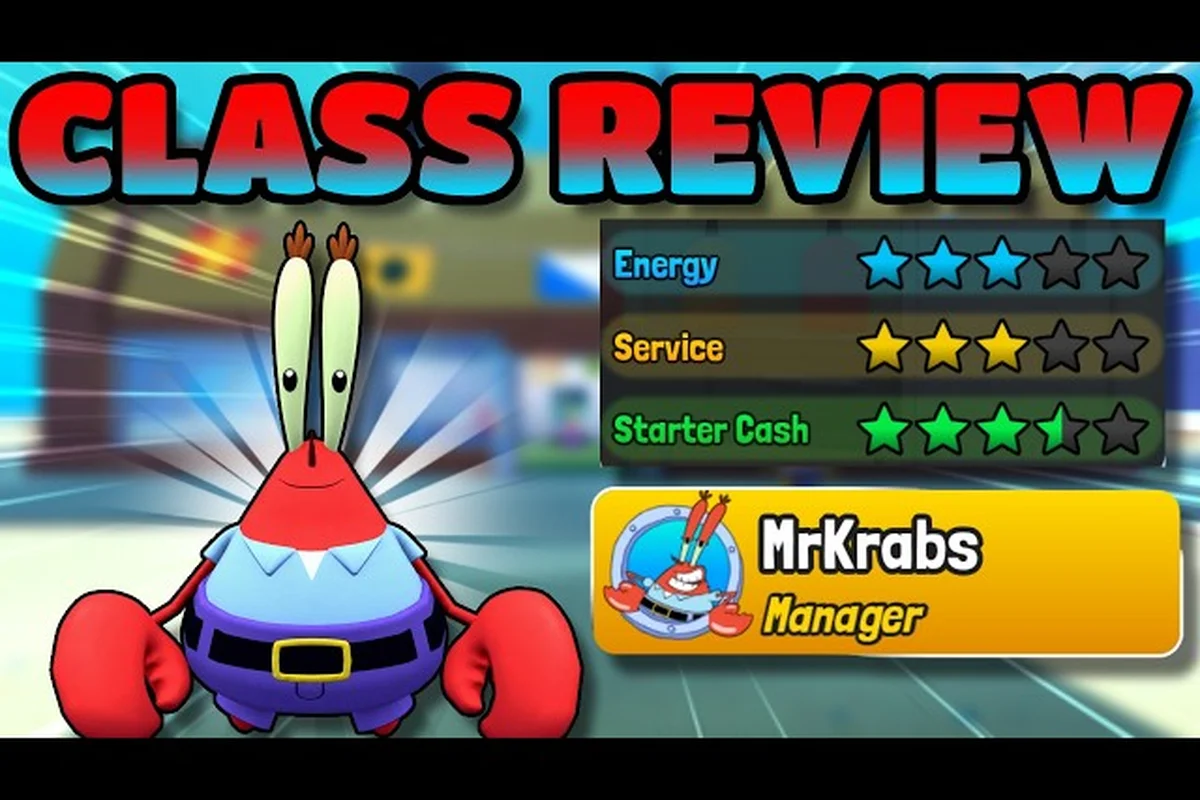
The Save the Krusty Krab manager class guide matters because extra tables, crew-wide cash gains, and stronger service stats can turn a slow opening shift into a much smoother operation. Learn how Mr. Krabs performs, when to buy him, and how his upgrades fit into a practical progression plan.
For additional guidance on the manager role, watch the YouTube guide for Save the Krusty Krab.
Mr. Krabs Manager Class Overview and Core Benefits
Mr. Krabs is the premium manager-focused class in Save the Krusty Krab. Community class breakdowns place him in the top tier alongside SpongeBob, and his defining advantage is a combination of starting income, additional table capacity, and an end-of-day cash bonus for the whole crew. The result is not simply more money after closing; the extra tables can also reduce congestion by giving customers more places to sit.
The strongest documented features are easy to understand. Community reports indicate that Mr. Krabs starts with roughly 100 starting cash, although that figure is a creator estimate rather than a developer-confirmed value. At level 1, he adds one starting table, and at level 2, he adds two starting tables. His most reliable passive is a 10% end-of-day cash bonus for the entire crew.
That crew-wide percentage makes Mr. Krabs more than a solo character choice. If other players are handling cooking, drinks, cleanup, and payments, a 10% end-of-day increase can reward coordinated work without requiring every teammate to own the same class. A practical class unlock priority overview can help compare his cost and role with alternatives before you spend your doubloons.
Manager Class Feature Summary
| Feature | Reported value | Practical effect |
|---|---|---|
| Starter cash | About 100 cash | Provides a small early purchasing cushion; treat as a community estimate |
| Level 1 table bonus | 1 table | Reduces customer congestion from opening |
| Level 2 table bonus | 2 tables | Creates more service capacity as the restaurant expands |
| End-of-day cash bonus | 10% for the crew | Improves end-of-shift cash when the team completes service |
| Main role | Management and income | Strong fit for coordinators and cash-conscious players |
These values should be treated carefully. The table count and crew bonus come from community field notes, while the starting-cash estimate was not independently confirmed. Save the Krusty Krab can receive balance changes, so players should check the in-game class panel before committing doubloons.
Why Mr. Krabs Works Well in Co-op
The ideal Mr. Krabs squad needs players who can benefit from added capacity without making his own job less valuable. A grill cook can produce more patties when fewer customers are waiting in a single queue, while a cashier can process orders without constantly redirecting patrons. This means the class is strongest when teammates specialize rather than all crowding around the same station.
Mr. Krabs also works acceptably in solo play, but his value is harder to realize because one player cannot operate every station simultaneously. Extra tables may help a solo manager serve more customers, yet they cannot substitute for hands at the grill, drink machine, or register. If you mainly play alone, compare the purchase cost with a flexible starter before committing.
Class Stats Explained
Save the Krusty Krab class stats explained through the interface can be confusing because a class may have several types of numbers, passive abilities, and progression bonuses. The important point is not to treat every figure as a direct damage score. For Mr. Krabs, capacity, revenue, and crew efficiency matter more than raw cooking speed, so understanding the distinction helps prevent an expensive mistake.
Players often focus on the largest visible number, but service classes are evaluated by how rarely they become the bottleneck. A manager who can keep customers moving and increase closing income may be more valuable than a character whose specialty is a task another player can cover. The Service stat is therefore best viewed alongside equipment, station access, and team composition.
| Stat or ability | What it represents | Why it matters for Mr. Krabs |
|---|---|---|
| Service | Effectiveness at restaurant operations | Supports smoother customer handling and management duties |
| Energy | Capacity to perform work before exhaustion | Affects how long the class can remain active |
| Starting cash | Money available at the beginning of a run | Gives the player an early head start, subject to confirmed in-game value |
| Table capacity | Number of customer places available | Mr. Krabs can add tables through class levels |
| Crew cash bonus | Extra money at the end of a completed shift | Rewards a coordinated team rather than only the manager |
The Save the Krusty Krab energy stat explained on a class card does not represent cash, customer patience, or table count. It is a work-capacity measure, and the precise cap is not published in a consistent developer dataset. Community observations also do not establish a reliable burn threshold, so avoid planning around a specific number unless your current game client displays it.
Service, Energy, and Cash Work Together
A strong manager rotation depends on all three systems. Service determines how effectively Mr. Krabs performs his role, while energy determines how long he can keep working before recovery becomes necessary. Starter cash then supplies flexibility: rather than interrupting the shift to wait for income, you can buy an immediate upgrade or cover a purchase that improves the rest of the run.
Think of the combination as a loop. Starting cash buys useful items, better service creates more completed orders, and the crew bonus increases the cash collected at closing. If a purchase slows you down or saves too little time, it may not support the loop even when it appears affordable. A Cash Timing assessment can help separate genuine efficiency from a temporary spending advantage.
Reading the Class Panel Correctly
The class panel should be treated as the final authority for live values. Look for the starting-money indicator, passive description, table count, and level rewards rather than relying on old screenshots. If the panel lists a different starting amount than community guides, the displayed client value takes priority because updates may have changed the balance.
Avoid turning a single attribute into an overall ranking. Service efficiency, energy endurance, and starting resources describe separate advantages, and Mr. Krabs can be excellent without leading every category. This distinction is particularly useful when comparing him with cooking, supporting, or specialist characters.
Energy Stat Explained for Daily Shifts
Save the Krusty Krab energy stat explained through practical play means tracking when exhaustion becomes a scheduling problem, not memorizing an unofficial cap. Energy is the resource that supports active work, while a depleted character must recover before contributing at full capacity. Mr. Krabs's extra tables and cash are valuable only if the team can keep those services running.
Because the energy limit is not published by the developer, use a repeatable test rather than a rumored number. Start a normal shift, note the point when the meter becomes empty, and observe how many station actions fit between full and empty. Repeat the test after upgrading relevant equipment. The result gives you a practical baseline for the current version without pretending it is a permanent rule.
| Energy state | Player action | Manager strategy |
|---|---|---|
| Full | Handle the highest-priority station | Open stations, clear bottlenecks, and direct teammates |
| Partially depleted | Continue efficient rotations | Avoid unnecessary travel and redundant station changes |
| Nearly empty | Prepare for recovery | Finish essential tasks, then switch to support or passive duties |
| Empty | Recover before critical service | Keep tables from clogging while the manager restores capacity |
| Recovered | Resume priority work | Rebuild the opening routine and check the remaining customer flow |
This method is more reliable than a fixed shift plan because customer volume, equipment, and team behavior can change the energy demand. The energy reserve should be reserved for the moment when every station needs attention. Spending it early on minor jobs can leave the manager unable to respond when several customers reach the same critical station together.
Energy and Starting Cash Synergy
Starting cash can reduce unnecessary energy expenditure when the right item is available. If a purchase permanently improves throughput, completing more orders with the same energy use creates a better return than repeatedly spending time on a weak temporary boost. This is where the Save the Krusty Krab starter cash stat becomes more than a number on the class card: it supports a faster opening without demanding an immediate recovery stop.
The estimated 100 starting cash should not be presented as confirmed fact. Community reports differ in confidence, and the authoritative in-game panel remains the best source. Instead, use the stat as a planning allowance. If your client shows 100, treat it as one early purchase opportunity; if it shows something else, adjust the opening buy without changing the broader strategy.
Service Stat Explained Through Real Scenarios
Save the Krusty Krab service stat explained in real scenarios shows why the manager role depends on team coverage. Mr. Krabs does not need to win every station interaction; he needs to keep the restaurant from becoming inefficient. That can mean taking urgent orders, directing traffic between stations, or using additional tables to prevent a queue from blocking the rest of the floor.
A useful comparison is to run the same early shift with and without extra capacity. The first test reveals whether customer density is the main problem, while the second shows whether energy or teammate speed is the actual constraint. If more tables help little, the issue may be a slow grill or weak cash handling rather than a lack of customer capacity.
| Situation | Likely bottleneck | Best use of Mr. Krabs |
|---|---|---|
| Customers wait to be seated | Insufficient table capacity | Use the level-based table bonus immediately |
| Orders pile up at one station | Teammate workload | Take overflow work and redirect other players |
| Register cash arrives slowly | Order handling | Keep customers moving and protect cash flow |
| Grill becomes crowded | Cooking speed or positioning | Add tables so finished orders do not clog the grill |
| Manager runs out of energy | Recovery timing | Finish urgent work, then delegate or recover |
These are service-pressure signals, not a promise that one class can solve every failure. A support class comparison is useful when another teammate lacks the station coverage Mr. Krabs cannot provide alone.
The Ten Percent Closing Bonus in Practice
The crew cash bonus is most valuable when the team completes service with enough customers served, enough money earned, and few costly interruptions. A 10% increase applied to a larger total can matter more than a small bonus on a weak shift. That encourages the team to keep the restaurant operating smoothly instead of chasing every possible customer immediately before closing.
Do not treat the bonus as permission to ignore preparation. A shift that ends with excessive delays may produce less cash even if the percentage is strong. Coordinate with the team, keep the highest-value stations staffed, and use Mr. Krabs's extra tables where they prevent a jam. For broader calculation, the no-mistake bonus breakdown explains how avoiding errors can also influence shift income.
What the Service Stat Does Not Solve
The Service stat does not automatically fix a poorly chosen equipment loadout, poor positioning, or teammates who repeatedly ignore queued orders. Mr. Krabs improves the team's operating foundation, but the crew still has to execute basic service tasks. A manager should therefore avoid taking every order simply because the stat is high; sometimes the best service decision is to leave a routine task with a faster specialist.
This is also why class buying order matters. Buying the first character that appears attractive can leave you with redundant abilities and no practical support coverage. A balanced sequence usually produces more reliable results than chasing a single top-tier pick.
Class Buying Order for New Players
A practical Save the Krusty Krab class buying order should account for doubloon cost, unlock role, and synergy with the free starter. Mr. Krabs is attractive, but “best” does not always mean “first.” If you lack another way to manage queues, improve starting cash, or coordinate the crew, his passives can become a strong foundation.
The current build reportedly includes ten playable classes: SpongeBob, Mr. Krabs, Squidward, Patrick, Sandy, Gary, Larry, Pearl, Jim, and Fred. Fred is the free starter, while the others are unlocked with doubloons. Community tier lists place SpongeBob and Mr. Krabs in S tier, Gary, Sandy, and Jim in A tier, Pearl, Patrick, and Larry in B tier, Squidward in C, and Fred in D, but tier position alone does not reveal unlock prices.
| Order | Purchase goal | Reason |
|---|---|---|
| 1 | Confirm the free starter and role coverage | Learn the service loop without spending doubloons |
| 2 | Buy a complementary station specialist | Gain coverage that the starter or Mr. Krabs cannot provide |
| 3 | Add Mr. Krabs if team management is desired | Gain starting cash, table capacity, and a 10% crew bonus |
| 4 | Add another high-tier operational class | Reduce bottlenecks in cooking, drinks, or order handling |
| 5 | Fill remaining roles based on team needs | Avoid buying duplicate comfort classes too early |
This order is a progression framework rather than a fixed price list, because the provided research does not include verified unlock costs. Check the in-game store for current doubloon requirements. The currency explained guide can help distinguish permanent class access from consumable spending before you commit.
When Mr. Krabs Should Be the First Premium Buy
Buy Mr. Krabs first when you want to lead a cooperative team, enjoy a management-heavy role, or have already identified strong teammates in other roles. His starting cash reduces the friction of the opening shift, while the table bonuses create breathing room that can make specialized teammates more effective. This is a particularly good fit when the group communicates clearly and can handle separate stations.
He is less compelling as an isolated purchase for a solo player who does not enjoy directing others. Without enough crew coverage, the extra tables may expose a different problem: more customers can begin orders at once, but there may not be enough hands to complete them. In that case, a character that solves a major station bottleneck may produce a better first purchase.
When to Save Your Doubloons
Save when you do not yet know which role your regular group needs. A seemingly weaker character can be more valuable if it covers a neglected station, while another S-tier character can overlap with what you already own. Before buying, list the stations your team struggles with, the tasks you perform most often, and whether your current classes can handle a busy opening.
Do not spend simply because the character appears in a strong tier list. The value of the crew-wide closing bonus rises with a coordinated team, whereas the table capacity bonus creates the greatest benefit in already busy shifts. If both conditions are weak, another purchase may produce a more noticeable improvement.
Advanced Manager Class Upgrades and Team Tactics
Advancing Mr. Krabs is not only about reaching level 2 for another table. The level 2 table layout gives him a meaningful opening advantage, but good progression also involves learning when to spend energy, when to let teammates handle a station, and how to convert the crew bonus into permanent improvements. A class level-up overview can help track available experience and promotion progress, but the manager guide should shape your in-shift decisions.
At level 1, use the first additional table to break up the initial customer cluster. Let the team learn the new flow before another layout change compounds the confusion. At level 2, the two added tables create even more flexibility, but only if the grill, drink station, and checkout are positioned so customers can move between them without creating a traffic jam.
A Reliable Opening Routine
Start by checking the team’s assigned stations, then place the first customers on the expanded table layout. Help the station that would otherwise become the earliest bottleneck, and use starting cash on an upgrade that improves long-term service rather than a small instant reward. This sequence makes the manager’s passive advantages work together instead of leaving them as isolated bonuses.
A practical opening routine is straightforward. First, identify the bottleneck station by watching where completed and newly ordered items accumulate. Second, assign one teammate to clear that queue before taking a routine task yourself. Third, use a free moment to direct new customers toward available seats. Fourth, purchase a useful upgrade when enough income arrives. Fifth, preserve enough energy to respond when two stations become overloaded at once.
Level-Up Priorities by Situation
| Situation | First priority | Secondary priority |
|---|---|---|
| Customers wait for seats | Unlock or use table capacity | Keep seating traffic away from stations |
| The grill is overloaded | Add cook coverage | Use tables to prevent order congestion |
| The register is slow | Take order or checkout work | Shift nonessential manager tasks to teammates |
| Team energy is running low | Recover the manager | Assign focused tasks during the break |
| Doubloons are available | Buy a missing role | Upgrade the class after coverage is secure |
The goal is not to keep Mr. Krabs at the busiest station. The class’s strongest contribution is system-wide throughput, and sitting on one task can make the team slower. A manager should intervene at the point of greatest congestion, then release the station when another player can handle it efficiently.
Protect the End-of-Day Bonus
The 10% crew bonus works only on income that actually reaches the end-of-day payout, so accurate order handling and uninterrupted service matter. Avoid risky speed plays near closing, especially if an error could erase part of the shift’s gains. A clean operation preserves both the base income and the manager’s percentage contribution.
Keep a simple distinction between cash and doubloons as well. Cash generally supports in-run purchases, while doubloons unlock classes and other persistent options. If a run ends with enough cash for a powerful upgrade but you spend your doubloons in the wrong order, you can still weaken future progression. The manager’s cash advantages should fund the run while the doubloon plan handles permanent access.
Frequently Asked Questions
Is Mr. Krabs the best class in Save the Krusty Krab?
Mr. Krabs is a top-tier choice for management-focused and cooperative play, but he is not automatically the best in every situation. His extra tables, estimated starting cash, and 10% end-of-day crew bonus shine when teammates can cover other stations. A solo player may gain more from a flexible character that handles a critical station.
How much starting cash does Mr. Krabs have?
Community reports estimate roughly 100 starting cash, but the figure has not been independently confirmed by the developer. Check the class panel in your current game client because balance changes may alter the displayed amount. Treat the estimate as a planning reference rather than a guaranteed stat when arranging your opening purchase.
Does Mr. Krabs give the whole crew a cash bonus?
Yes, community field notes describe a 10% end-of-day cash bonus for the entire crew. This passive is especially valuable in co-op because it rewards completed service across the team. It does not replace careful cash handling, since lost or failed orders can reduce the total cash to which the bonus applies.
Should players buy Mr. Krabs before other classes?
Buy Mr. Krabs first if you enjoy coordinating a team or want stronger opening capacity and crew income. Otherwise, buy a complementary station specialist before adding another manager. Compare the current doubloon price, your available roles, and the stations your group handles least effectively before spending.
What does the energy stat do for the manager class?
Energy represents how much active work the class can perform before recovery becomes necessary. Mr. Krabs should save it for critical bottlenecks rather than spending it on routine tasks teammates can handle. Because no consistent official energy cap is published, test the current meter and use the in-game value rather than relying on an unsupported number.