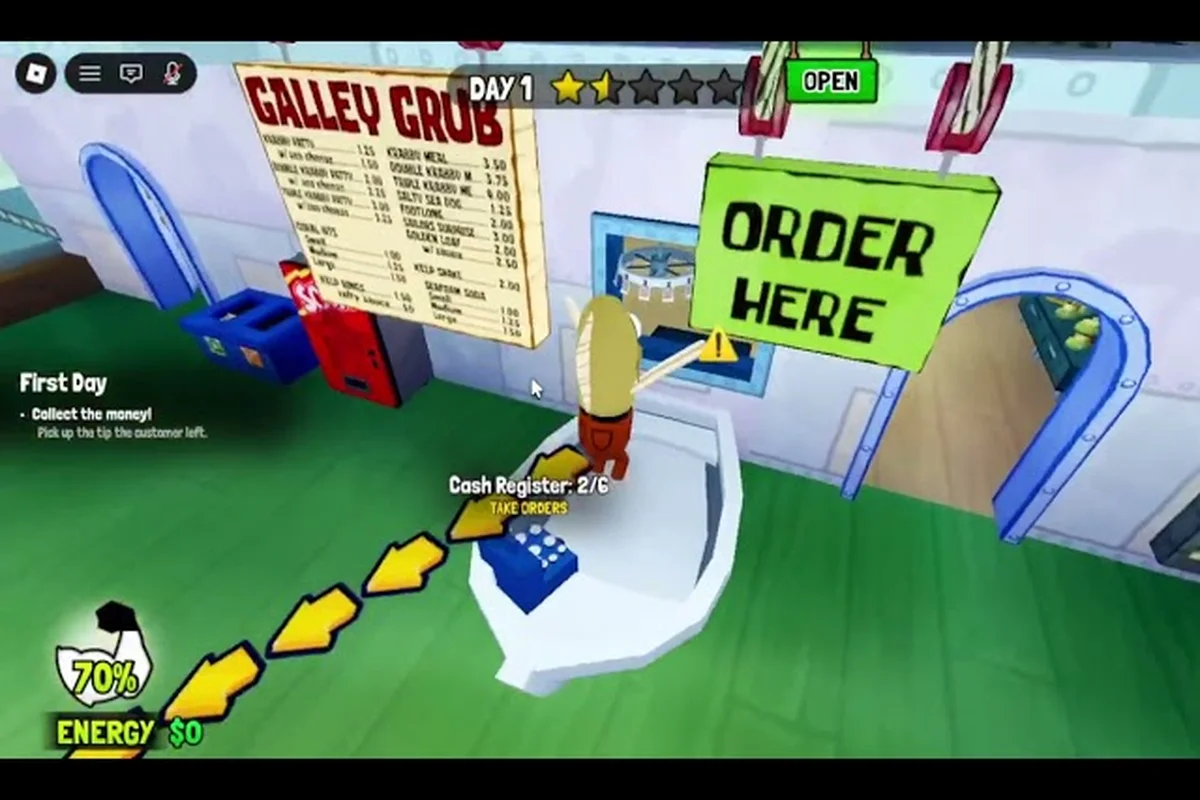
Save the Krusty Krab beginner guide helps you survive the first ten days by mastering orders, cooking, drinks, cleaning, and complaint control. A clean routine matters because mistakes quickly lower your restaurant’s star rating and end-of-day cash result.
Beginner Guide: Your First Shift Setup
Starting Save the Krusty Krab can feel busy because several stations demand attention at once, but the early game rewards a simple routine. Learn where each station sits, what must be cooked, and which cleanup tasks cannot be postponed. That foundation lets you handle growing queues without sacrificing food quality.
The register station records incoming orders. The grill cooks patties, while the assembly counter combines food and drinks. The soda fountain and kelp shake machine prepare beverages separately, and the dining room becomes essential for delivery, complaints, and cleanup. Community field notes identify these as the principal stations in the current build.
| Station | Main responsibility | Common early mistake |
|---|---|---|
| Register | Read and confirm customer orders | Accepting an order without checking its contents |
| Grill | Cook patties to completion | Leaving a patty until it burns |
| Assembly counter | Combine the requested items | Forgetting a drink or adding the wrong item |
| Soda fountain | Prepare soda drinks | Delaying a drink while food gets cold |
| Kelp shake machine | Prepare kelp shakes | Treating the drink as part of the food ticket |
| Dining room | Deliver orders and handle messes | Leaving spills or complaints unattended |
Start with the opening checklist
Clock in only after you have checked the grill, assembly area, drink machines, and dining room. Look for abandoned plates, spills, or unfinished orders before accepting the first customer. This prevents old problems from competing with new orders, and it also gives you a clear picture of what needs immediate attention.
| Startup task | What to inspect | Reason it matters |
|---|---|---|
| Grill condition | Empty spaces, burn marks, abandoned patties | Prevents starting with a compromised station |
| Dining room | Tables, floor, chairs, customer issues | Clears existing complaint sources |
| Drink stations | Soda supply and kelp shake machine | Avoids delays after an order arrives |
| Assembly area | Counter space and available ingredients | Speeds up order completion |
| Order queue | Register display | Reveals the first demand pattern |
For a more detailed opening and closing routine, the Save the Krusty Krab first shift walkthrough provides a practical station-by-station checklist. Use it alongside this guide rather than trying to memorize every control at once.
Learn the movement loop
A reliable first shift follows the same sequence: take the order, cook the food, prepare any drink, assemble the tray, deliver it, then clean the table. When you can complete that cycle without skipping stations, you will notice mistakes earlier and respond before customers become unhappy.
The order-to-delivery loop is the central task pattern: each customer order creates a chain of linked actions at the register, grill, drink station, assembly counter, and dining room. For example, a Krabby Patty order with a soda requires four separate work areas, and the soda can spoil the workflow if you prepare it too early. Thinking in stages helps you spot a missing drink, incomplete patty, or wrong table before the customer reacts, reducing remakes and keeping the first shift manageable.
-
Read the complete order at the register.
-
Cook the required patty at the grill.
-
Prepare any soda or kelp shake at its separate machine.
-
Assemble the food and drink at the counter.
-
Deliver the finished order to the correct table.
-
Clear the table and handle any complaint before taking another order.
Do not treat a drink as a garnish. Drinks require separate preparation, so a single player may need to move between the fountain and dining room during a rush. That travel distance is part of the challenge, not a failure of your setup.
How to Play: Orders, Cooking, and Service
Good service depends on reading the entire order before beginning. Prepare only what the customer requested, keep track of table numbers, and use the assembly counter as the final checkpoint. Rushing between stations may save a few seconds at one task while causing a much larger problem elsewhere.
Read orders as checklists
Treat every order as a set of separate requirements. One customer may need a patty and soda, while another may request a different food combination plus a kelp shake. Confirm the food and drink before delivery because an incorrect or incomplete order can produce a complaint.
| Order type | What to prepare | Final check |
|---|---|---|
| Standard patty order | Cooked patty plus requested toppings | Food matches the ticket before delivery |
| Food and soda | Cooked meal plus a soda drink | Soda is present and belongs to that table |
| Food and kelp shake | Cooked meal plus kelp shake | Shake is prepared separately and added at assembly |
| Multi-item request | Every listed food and drink | Read the ticket from top to bottom |
| Special request | The specified combination only | Do not substitute a similar item |
Community footage shows that missed or incorrect items feed into the complaint system. Since complaints reduce the restaurant’s star rating, preventing them is more valuable than trying to recover a poor rating after several mistakes. This is the central lesson in the current Save the Krusty Krab game guide for early customers.
Cook patties with constant attention
Place the requested patty on the grill and stay nearby while it cooks. A patty left too long can burn, turning a normal order into a complaint. Pull the patty when it is visibly ready, then bring it directly to the assembly counter.
| Cooking state | What it means | Correct action |
|---|---|---|
| Raw patty | Still needs cooking | Leave it on the grill and monitor it |
| Cooked patty | Ready for assembly | Move it to the counter promptly |
| Burned patty | No longer suitable for service | Replace it before assembling the order |
| Extra patty | Unserved food that may be abandoned | Grill only what active orders require |
Burned patties are a leading self-inflicted complaint source in community observations. Do not attempt to hide minor color variation by rushing a patty off the grill. If the game marks it as burned, discard it and restart that portion of the order.
Assemble, deliver, and confirm
Build the order at the assembly counter after both the food and drink are ready. Confirm that the tray matches the order and then carry it directly to the customer’s table. Once the meal is delivered, return to the register or grill rather than lingering beside the table.
A good quality-control habit is to scan the order one final time immediately before leaving the counter. Ask yourself three questions: Is the patty cooked? Is the requested drink included? Is the meal going to the right table? These checks are fast, and they prevent the expensive delay of cleaning up a complaint.
First Day Guide: Avoiding Early Mistakes
Your first day is a learning shift, not a speed test. Establish a clean workflow while customer volume is manageable, then preserve that workflow as demand rises. The most damaging mistakes involve neglect: burning food, forgetting drinks, leaving messes, and allowing complaints to remain unresolved.
Prioritize tasks by consequence
Some actions affect only one order, while others can affect several customers at once. A burned patty delays one ticket, but an unattended table or unresolved complaint may interfere with the restaurant’s broader performance. Use this priority order when the floor becomes busy.
| Priority | Action | Reason |
|---|---|---|
| 1 | Resolve a complaint or visible damage | Stops one issue from affecting the restaurant rating |
| 2 | Finish a nearly completed order | Delivers value already spent on preparation |
| 3 | Cook the next requested patty | Begins a new order without leaving it unattended |
| 4 | Prepare a missing drink | Completes a ticket that may otherwise wait |
| 5 | Clean an ordinary table | Improves the floor before it becomes disruptive |
| 6 | Begin a brand-new order | Adds workload only when current work is controlled |
Task triage prevents panic loops, where a new customer triggers another task and each added job becomes harder to remember. Before starting anything new, scan the floor for active problems and the counter for parts that are already prepared. For example, if a customer’s order is missing a drink but the patty is nearly cooked, clear the ticket’s current stage first rather than opening another order; interrupting an active task can leave multiple stations waiting at once. Once the current order is complete, move to the next item in the priority table instead of creating a fresh queue of unfinished work.
Clean as you go
Do not save every cleaning task for the end of a shift. Clear tables and spills during natural service gaps, especially when the grill is idle, so you can reposition the dining room and handle incoming customers without obstacles. For example, wiping a recently used table during a lull prevents dirty dishes from blocking the next delivery route; a small cleanup now can prevent a larger obstruction later.
| Cleaning moment | Why it is efficient |
|---|---|
| After delivering a table | The table is already nearby and recently used |
| While the grill is occupied | The player can use otherwise idle movement |
| Before a customer sits | Prevents a fresh mess from forming |
| After resolving a complaint | Removes any remaining issue at that table |
| During a short queue lull | Keeps future service from becoming cluttered |
The dining-room route matters because delivery and cleaning are closely connected. Wipe the table and clear the dishes before moving to another customer whenever possible. For additional day-specific priorities, compare the opening pattern with the Save the Krusty Krab day guide.
Keep a mental ticket queue
You probably do not need a separate spreadsheet, but you should track essential order details in your head. Remember the table, food, drink, and whether either component is still being prepared. If several orders overlap, focus on finishing two nearly complete tickets before starting more components.
A useful three-ticket rule prevents overload: keep no more than three active orders in your mental queue. If a fourth appears, finish, cancel, or complete one of the first three before taking on another task. The exact customer limit is not officially published, so this is a practical routine rather than a confirmed game mechanic.
Full Walkthrough Strategy for Days 1–10
Your first ten days introduce a broader mix of customers, complaints, and restaurant conditions. The Save the Krusty Krab full walkthrough approach is not about memorizing one flawless route. It is about repeating a dependable shift cycle, spotting which problem appears first, and adjusting before the star rating drops.
Keep every shift cycle identical
Consistency reduces the number of decisions you have to make. Use the same order sequence every day, regardless of whether the customer arrives alone or creates a larger queue. Familiarity lets you recognize mistakes more quickly, especially when multiple customers are waiting for different drinks.
| Shift phase | Main objective | Practical check |
|---|---|---|
| Opening | Clear existing problems | Inspect grill, floor, and drink stations |
| Early orders | Learn the standard routine | Confirm food and drink before delivery |
| Busy period | Finish work in a fixed priority | Avoid starting unnecessary extra patties |
| Late service | Resolve remaining tickets and complaints | Check every occupied table |
| Closing | Leave the restaurant clean | Remove spills, dishes, and abandoned food |
Community field notes support a simple interpretation: complaints reduce the star rating that influences the end-of-day cash result. Exact formulas for customer growth, patience, burn timing, and star thresholds are not published consistently. Treat precise percentages or timers from other players as version-dependent observations, not guaranteed rules.
Adapt to customer behavior
New customers may be more forgiving, while later customers may create complications such as damage, wrong-item complaints, or faster service demands. Watch the order indicators and customer animations rather than assuming every shift behaves like Day 1. If a customer is visibly impatient or creates trouble, finishing another customer’s correct order may still be the safer priority.
| Situation | Likely risk | Best response |
|---|---|---|
| Customer waits while the order is incomplete | Complaint or reduced patience | Finish the nearest valid order |
| Several drinks are requested | Station travel conflict | Start the first drink, then continue cooking |
| A table becomes messy | Cleaning obstruction | Clear it during a nearby trip |
| A patty is close to burning | Food loss | Prioritize the grill over distant cleaning |
| An order is wrong | Complaint | Replace or correct the item immediately |
| A customer causes damage | Wider service disruption | Handle the damaged table first |
Learn from each day’s result
At the end of a shift, review the result screen for stars and cash, then identify the most common failure. If cash is lower, determine whether the cause was slow service, poor accuracy, burned patties, or unresolved complaints. Make one adjustment for the next day rather than changing everything at once.
| Result pattern | Likely lesson | Next-day adjustment |
|---|---|---|
| Good rating, low cash | Throughput may be too low | Reduce unnecessary travel |
| Low rating, normal cash | Service quality needs attention | Double-check orders and complaints |
| Low rating and low cash | Multiple problems occurred | Simplify the routine and prioritize cleanup |
| High cash, poor rating | Fast work caused sloppy service | Slow down at final checkpoints |
| Consistent performance | Routine is working | Make only small optimizations |
A visual Day 1 to 10 gameplay walkthrough by AnyaRoblox can help you compare station sequences and see how routines develop across the opening stretch. Use it for visual reference, not as a source of exact numerical formulas.
Game Guide: Complaints, Villains, and Recovery
Complaint control is where basic service becomes a higher-level skill. By Day 10, you may face customers who cause damage or create disorder in addition to ordering food. A strong player does not treat every interruption identically; they identify the source, contain it, and resume the order cycle.
Identify the complaint source
The complaint category matters because the response should match the problem. A missing drink requires a replacement, a burned patty requires a new patty, and a dirty table requires cleanup. Simply ignoring an early complaint does not make it disappear.
| Complaint signal | Underlying problem | Recovery action |
|---|---|---|
| Wrong item served | Order was misread | Correct the item and confirm the ticket |
| Missing drink | Drink was omitted | Prepare the correct drink immediately |
| Burned food | Patty stayed on the grill too long | Replace it with a fresh patty |
| Dirty table | Cleanup was delayed | Clear the table and surrounding area |
| Customer damage | A disruptive event occurred | Address the affected table and customer |
| Slow service | Too many unfinished tasks | Finish the closest valid order |
Accurate recovery is better than defensive rushing. Replacing the right item while the order is still visible prevents confusion, and cleaning the table as part of the delivery trip reduces extra movement. The detailed Save the Krusty Krab nasty patty guide becomes useful once harder customers and damage events begin increasing pressure.
Contain villains and damage
Villain activity can interrupt the basic cooking loop. Treat it as a separate priority rather than assuming the order queue will remain stable. Clear the danger, repair or clean the affected area if required, and then confirm that no customer is still waiting for a partially prepared order.
Do not invent a universal spawn schedule. Community data does not provide a consistent published pattern for villain appearances, so their timing should be treated as an observation. The dependable rule is to respond to the on-screen threat and protect the restaurant’s active tables.
| Danger phase | Player focus | What to postpone |
|---|---|---|
| Threat appears | Identify the affected area | Distant cleaning and speculative cooking |
| Immediate action | Contain the villain or damage | Unnecessary extra food |
| Aftermath | Handle complaints and clean damage | New orders that are not yet active |
| Resume service | Rebuild the order queue | Unfinished work that no longer matters |
Recover Without Losing the Queue
One bad patty does not automatically end a shift, but repeated unhandled mistakes do. After replacing a wrong or burned item, return to the register and reread the active order. Confirm that the replacement completes the ticket rather than fixing only part of the problem.
Use a short recovery sequence to keep one damaged order from contaminating the rest of the shift. For example, if a Krabby Patty is burned while another order is waiting, pause the cooking station, replace the patty, and resume the active order only when the replacement is ready. This matters because an unresolved mistake can tie up a work station, delay neighboring customers, and reduce accuracy on the next ticket.
-
Stop the immediate mistake from worsening.
-
Correct the affected food, drink, or table.
-
Clear any resulting mess.
-
Reconfirm the customer’s order.
-
Resume normal service only when the station is stable.
The most important recovery metric is the next clean order. A successful correction is not merely removing the complaint; it is preventing one mistake from turning into a chain of slow service, additional complaints, and lower performance. For example, if a replacement Krabby Patty is ready but the original ticket still shows a missing item, verify the order before handing it over; otherwise, the next clean order may be delayed by a mismatch at the register. Treat a stable cooking station, an accurate ticket, and a clear customer handoff as the practical checkpoint that service can safely resume.
Advanced Beginner Habits for a Strong Progression Run
Even during the first ten days, small habits can prepare you for later difficulty. Faster movement, clearer station awareness, and better order memory become more valuable when customers, complaints, and villains overlap. The goal is not to complicate the opening shift but to create repeatable efficiency.
Reduce unnecessary travel
Stand close to the station needed next and plan a two-task route. For example, finish a table near the dining room on the way to the soda fountain, or carry a cooked patty directly from the grill to the assembly counter. Only combine tasks when doing so will not cause food to burn or an order to be forgotten.
| Efficient route | Tasks combined | Caution |
|---|---|---|
| Grill to assembly | Cook and assemble food | Do not delay a nearly burned patty |
| Fountain to table | Prepare drink and deliver | Verify the correct table |
| Table to register | Clean and accept order | Address complaints first |
| Register to grill | Start a confirmed order | Do not overcommit to multiple patties |
Build a visual order memory system
Look at the order display every time you return to the register. Some players group orders by food type, while others remember table numbers. Either system works if it is consistent and if you also remember which orders require drinks.
For extra support, the Save the Krusty Krab Krabby Patty recipe can clarify burger assembly and menu items. Use the recipe reference only as a preparation aid; the active customer order remains the final authority for what belongs on the tray.
Practice under controlled pressure
Do not create extra stress by cooking patties nobody ordered. That adds burn risk and clutters the grill. During quiet moments, review where customers are sitting, which table needs attention, and which item is closest to completion. This makes the shift more efficient without asking the game to create a harder scenario.
| Available moment | Productive practice | Avoided problem |
|---|---|---|
| No active customer | Check the dining room | Letting small messes accumulate |
| One active order | Prepare each required component | Cooking unneeded extras |
| Several customers | Finish nearly complete tickets | Fragmented attention |
| Grill occupied | Clean a nearby table | Standing idle |
| Complaint active | Correct the affected order | Letting a mistake spread |
Consistency means repeating a system that works, not forcing constant speed. Keep the routine stable through Days 1–10: use the same prep order, check the grill before starting each patty, and clear one table before taking another ticket. For example, if you can finish a Krabby Patty, fries, and drink without a burned patty or a dirty table, repeat that sequence even when customer traffic rises; adding complexity before the basics hold can turn a manageable rush into a cascade of wrong orders and unfinished tables.
Frequently Asked Questions
What should I focus on during my first day in Save the Krusty Krab?
Focus on learning the order-to-delivery loop: accept the order, cook the patty, prepare any drink separately, assemble the complete meal, and deliver it to the right table. Clean nearby tables while moving around the dining room. Burned patties, missing drinks, and unattended complaints are common early problems, so check each order before leaving the assembly counter.
How do I stop complaints from lowering my star rating?
Respond to the source of each complaint as quickly as possible. Replace a wrong or burned item, prepare a missing drink, or clean the affected table. Because complaints influence the restaurant’s star rating and end-of-day cash result, prevention is preferable: confirm the order, keep the patty under supervision, and do not start extra cooking during a rush.
Are drinks prepared on the same station as food?
No. Drinks are handled separately through the soda fountain and kelp shake machine, while food is cooked and assembled at the grill and assembly counter. This separation creates extra travel for a solo player. Prepare the drink as soon as you understand the order, but never let a patty burn while making a long drink run.
Is a higher star rating always better in the first ten days?
A higher star rating generally signals better service, and it also affects the end-of-day cash result. However, rushing to maximize the rating can create new errors. Prioritize accurate orders, cooked food, completed drinks, clean tables, and resolved complaints. A dependable routine that produces consistent ratings is stronger than a fast method that repeatedly burns patties or serves incorrect items.
What is the best way to prepare for Days 5 through 10?
Use the same station routine, but pay closer attention to customer behavior, damage events, and complaint signals. Keep the basic priority order: handle active problems, finish nearly complete orders, then start new tasks. Do not rely on unverified timers or spawn schedules, because exact customer growth and villain timing can vary; instead, respond to the events visibly present during each shift.