
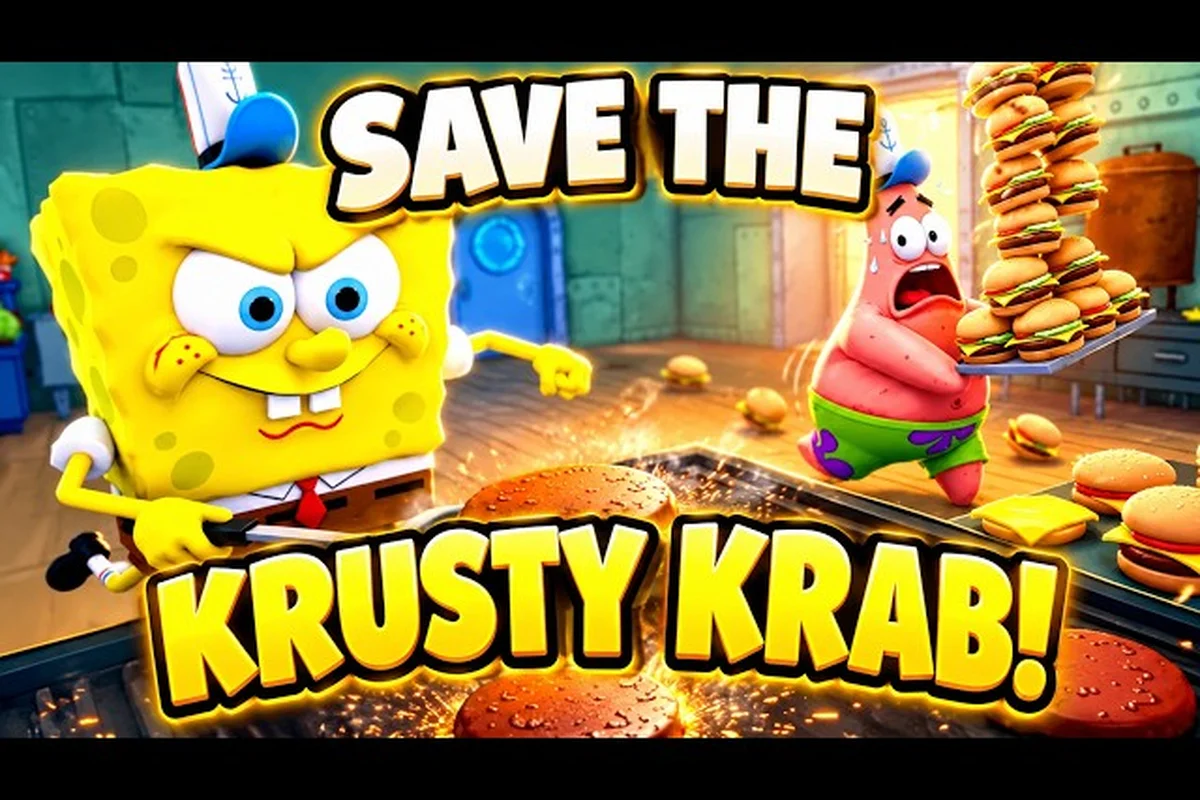
Save the Krusty Krab run planning matters because energy drains, star losses, and rising customer pressure turn Days 5–30 into the game’s first major progression wall. Community data shows 66.4% of players reach Day 5, but only 22.8% reach Day 10, so a deliberate plan can turn a fragile run into a stable recovery path.
Run Planning for Days 5 to 30
The jump from Day 5 to Day 30 is less about a single difficult customer and more about protecting your restaurant across repeated mistakes. Once orders overlap, fires appear, and villains interrupt the work area, small errors compound quickly. Strong Save the Krusty Krab run planning treats energy, stars, money, and upgrades as connected resources instead of separate tasks.
A reliable run follows three principles: prevent avoidable energy loss, keep enough money available to recover after a bad shift, and upgrade when the next bottleneck becomes predictable. The Save the Krusty Krab day guide can help establish the normal rhythm of earlier days, while this guide focuses on the decisions that matter after the initial learning period.
| Run phase | Primary goal | Main resource to protect | Best planning focus |
|---|---|---|---|
| Days 5–9 | Stabilize the workflow | Energy | Consistent order routing and fewer mistakes |
| Days 10–15 | Restore lost momentum | Stars and money | Emergency recovery procedures |
| Days 16–24 | Scale the restaurant | Upgrades and capital | Bottleneck-driven purchases |
| Days 25–30 | Reach the next gate | Run survivability | Conservative pacing and reserve funds |
This phase structure prevents common planning errors, including spending every dollar immediately or buying an upgrade before understanding which station causes most delays. Since exact energy caps, customer timers, and star formulas have not been published consistently, the safest approach is based on observable behavior: mistakes consume energy, Kelp shakes restore it, and clean execution prevents most of the drain.
Build a three-part resource plan
Effective Save the Krusty Krab run planning starts with a simple resource ledger. Track three things after every difficult day: how much energy remained, whether the star rating fell, and how much money was available for repairs or upgrades. This creates evidence for the next session without pretending that unpublished numbers provide exact answers.
Use these qualitative outcomes to classify each session instead of assigning an unverified success rate: stable, strained, or critical. For example, label a run strained if energy finishes low or stars decline while money remains sufficient for essential repairs, and critical when both stars and money collapse. This classification turns the Save the Krusty Krab resource ledger into a clear decision for the next shift, helping the Save the Krusty Krab star recovery guide distinguish a temporary energy problem from a deeper bankruptcy threat without inventing exact percentages.
| Observation | Likely meaning | Next-session response |
|---|---|---|
| Energy ended low without major mistakes | Workload or routing became too dense | Slow down, assign clearer order priorities |
| Energy dropped after mistakes | Burn, clutter, or service errors consumed resources | Use kelp shakes and practice prevention |
| Stars fell but money remained | A quality metric was missed | Review customer completion, not just purchases |
| Money fell with little visible reward | Overspending on premature upgrades | Delay nonessential purchases |
| Both stars and money fell badly | Run may be approaching bankruptcy | Set a recovery reserve before continuing |
This ledger supports the Save the Krusty Krab progression guide because it turns each setback into a targeted adjustment. If the same resource fails twice, change the routine instead of simply repeating the attempt. This is especially important between Days 5 and 10, where community observations show the largest initial drop in player retention.
Treat kelp shakes as recovery, not endurance
Kelp shakes are most valuable as an energy recovery tool, according to community field notes. That makes them different from a permanent extension of your best shift. Save them for moments when preventing further mistakes would otherwise be impossible, such as after a fire or a costly routing error, rather than consuming them automatically during every quiet lull.
A practical energy reserve has three levels: treat each level as a decision threshold rather than a fixed energy percentage, because the cost of a mistake changes faster than the energy bar alone can show. In a Save the Krusty Krab run, spending one kelp shake to protect a 1-star order may be wasteful, while using it to prevent a 2-star order from slipping into a chain can be worthwhile. Count both the immediate order value and the stars at risk, then preserve recovery resources for situations where a small error would trigger a much larger loss.
-
Green state: Energy remains comfortable, so avoid unnecessary shake use and protect the current rhythm.
-
Amber state: Energy is visibly declining, so finish the simplest active order first and remove a source of mistake before using a recovery item.
-
Red state: Energy is low enough that mistakes are becoming difficult to recover from, so stabilize the restaurant immediately with a kelp shake and then rebuild cautiously.
Save the Krusty Krab energy management is not about finding a perfect item rotation. It is about preventing a chain reaction in which one mistake leaves less energy, lower energy causes another mistake, and the second mistake removes more stars. Clean play remains the best way to preserve resources because every avoided mistake protects both the energy bar and the rating.
Energy Management Under Pressure
Days 5–10 increase the number of simultaneous demands, making Save the Krusty Krab energy management more important than memorizing individual stations. The player must decide which customer can wait, which task has the greatest consequence if ignored, and whether a clean reset is safer than forcing completion during a busy moment.
The central problem is attention density. A restaurant can have enough station capacity on paper while still failing because one player is trying to cook, clean, serve, and manage hazards simultaneously. A good plan assigns a stable order to each active station, then allows a delay only when the delayed task is less urgent than the task threatening the current shift.
Build a priority ladder
During crowded service periods, scan the restaurant and assign one immediate task before starting another: contain fire or power loss first, finish the most time-sensitive customer order next, then clear only the station required for that order. For example, if a grill fire threatens a live order, extinguish it immediately and reset the affected station before starting optional maintenance; this prevents energy loss, duplicate preparation, and the broader service collapse that can jeopardize star progress.
| Priority | Action | Reason |
|---|---|---|
| 1 | Remove immediate hazards | Prevents cascading fires and energy loss |
| 2 | Complete the most time-sensitive active order | Limits customer and rating pressure |
| 3 | Clear the station needed for the next order | Prevents duplicate preparation |
| 4 | Handle lower-value maintenance | Protects flow without delaying service |
| 5 | Optimize or upgrade during a lull | Avoids risky spending during active pressure |
This ladder is more dependable than reacting to whichever object is closest. It also creates a repeatable method for the Save the Krusty Krab star recovery guide, because stars generally suffer when service collapses rather than when one optional task is delayed.
The broader day-by-day structure is covered in the Save the Krusty Krab beginner tips and tricks, but the Days 5–30 difference is urgency. Early days are best used to learn the routine; later days require you to abandon imperfect routines that consume too much attention.
Control mistakes before attempting speed
Speed is useful only when it reduces total work. Rushing between stations can cause spills, burns, or incorrect orders, each of which wastes time and energy. Before a busy stretch, remove visible clutter, finish partially prepared items, and choose one clear route through the restaurant.
A good pre-pressure checklist turns each station interaction into a deliberate sequence rather than a reaction to a rising mistake rate. Start with the immediate bottleneck—such as clearing the griddle or canceling a drink that is no longer needed—then verify that the order can be completed without another emergency action. This matters because a kelp shake can erase one mistake but not the extra prep time, lost resources, or future orders caused by leaving the station unstable.
- Identify the next order that must be completed first.
- Clear the station needed for that order.
- Remove any active fire or immediate hazard.
- Avoid optional actions until the station is stable.
- Use a kelp shake only when the current mistake rate is rising.
The prevention-first rule is the most dependable part of this progression advice because it works even when exact drain values differ by version or player state. It also prevents energy management from becoming a sequence of emergency item presses with no underlying plan.
Use recovery during controlled lulls
A recovery shake is safer when the restaurant is stable. After using one, complete the interrupted order and clear the station before starting a new chain. Saving a shake while several customers are active can reverse its value, because the recovered energy may be spent repairing mistakes caused by the original crisis.
When you need broader operational help, the Save the Krusty Krab delivery station guide explains how delivery, cleaning, trash, and fire prevention affect the same workflow. That matters because station failures are often connected: clutter increases danger, danger burns food, and a failed order consumes more time and energy.
Star Recovery Guide After a Bad Day
A lost star is both a rating problem and an economic problem. It can reduce customer confidence, reduce income, and make a recovery run harder to finance. The Save the Krusty Krab star recovery guide therefore starts with diagnosis: determine whether the rating was lost through errors, unfinished customers, poor order quality, or a combination of those problems.
Because the precise star-rating formula is not published in a dependable official source, avoid claiming that one error always equals a fixed star loss. Instead, use the change as feedback. A fall from five to four stars suggests a different recovery task than a fall from two to one, even if both result from a poor shift.
Find the First Failure in the Chain
Review the day in sequence and pinpoint the first point where the workflow broke, rather than treating every later setback as equally important. For example, if a burned grill stopped service before a misplaced order or weak cash flow became visible, record that fire as the initial failure and trace its effect on cooking speed, order completion, and available funds. This first-cause analysis makes the Save the Krusty Krab run planning process more precise: it distinguishes an equipment problem from an energy-management problem, such as running out of energy while handling a customer, and prevents a costly upgrade from masking the original breakdown.
| First visible failure | Likely cost | Recovery focus |
|---|---|---|
| Fire or burn | Time, energy, possible order failure | Fire prevention and quick hazard removal |
| Cluttered station | Slower movement and repeated interruptions | Cleaning before cooking |
| Wrong or incomplete order | Lost reward and customer confidence | Verify order stages before serving |
| Unattended customer | Reduced satisfaction and rating pressure | Assign one active order per station |
| Excessive purchases | Weak finances and fewer recovery funds | Pause upgrades and rebuild capital |
This diagnosis is what turns the Save the Krusty Krab progression guide from a sequence of upgrades into a repeatable cycle. After identifying the first failure, change only the most relevant routine during the next attempt. Changing everything at once makes it difficult to determine which adjustment worked.
Rebuild a two-day recovery rhythm
When stars fall, do not immediately chase the rating with risky purchases such as new decor or equipment. First restore a clean operating routine: prevent missed orders, reduce station congestion, and protect enough cash to absorb another failed cycle. Then rebuild income and stars before upgrading anything else. For example, if the star decline follows two incomplete orders, clear the bottleneck and finish active orders before spending, because each completed order restores both money flow and rating progress. A two-day recovery rhythm can look like this:
-
Recovery day: Focus on prevention, completing active orders, and leaving a small cash reserve.
-
Rebuild day: Use the improved routine to restore income, then make only the most necessary upgrade.
-
Stabilization check: Compare energy, stars, and money. Continue the rhythm while all three improve.
| Recovery checkpoint | Green result | Warning result | Correction |
|---|---|---|---|
| Energy | Stable or improving | Still falling despite clean play | Review routing and station congestion |
| Stars | Recovered or stable | Another decline | Find the earliest failure in the chain |
| Money | Reserve restored | Still below the safety threshold | Stop optional spending |
| Player decision | Continue progression | Attempt bankruptcy | Reset with a cleaner plan |
The two-day recovery rule is useful because it prevents one bad day from turning into several rushed days. It also gives the run enough time to prove that the correction works. If the same early failure appears twice, the correction is not yet strong enough.
For deeper rating mechanics, compare this recovery process with the Save the Krusty Krab five star restaurant reference. The goal is not to assume a specific formula, but to understand which operating habits support a high rating.
Run Planning for Upgrades
Upgrades should remove a measured bottleneck, not merely look impressive on the menu. During Days 5–30, the best purchase is usually the one that prevents the first repeated failure or reduces the amount of attention required by a station. Save the Krusty Krab run planning becomes more effective when every purchase has a clear purpose.
The community data does not provide a verified daily growth curve or an official upgrade-value formula, so purchase recommendations should be based on the player’s recurring problem. A station that causes three interruptions may be a better upgrade target than a station that is inconvenient only once.
Match upgrades to observed bottlenecks
| Repeated symptom | Upgrade category to consider | Evidence before buying |
|---|---|---|
| Orders wait because preparation is slow | Cooking capacity | Several prepared items repeatedly miss service windows |
| Finished food remains blocked | Delivery or serving capacity | Completed items repeatedly occupy the same point |
| Cleanup repeatedly interrupts service | Cleaning capacity | Clutter causes missed actions during active orders |
| Hazards happen too often to manage | Fire prevention | Burns repeatedly end the shift early |
| Too many customers remain active | Customer flow or patience support | Customers routinely wait while another station is idle |
This table does not prescribe a universal upgrade order. It prevents spending based on availability. If two categories appear equally useful, choose the one that affects the earliest stage of the order path, because preventing a failure before it starts saves more attention than repairing its consequences later.
Keep an upgrade reserve
A reserve is money that cannot be spent on an optional upgrade. It exists for emergencies such as fire recovery, lost income, or an opportunity to correct a poor purchase decision. The exact reserve size depends on the day, visible income, and the player’s purchase history, but the principle remains stable: do not confuse cash on hand with safe cash.
A simple purchasing plan can use three buckets, but reserve allocation should be reviewed whenever daily income or expenses shift. For example, if a planned upgrade would leave the run with less cash than several consecutive shifts require, postpone it until the Save the Krusty Krab budget has room for payroll, repairs, and a recovery margin. This prevents a short-term profitability spike from forcing a premature purchase and turning a manageable deficit into a Save the Krusty Krab bankruptcy during a later energy-management crunch.
-
Operating cash: Money needed for the next shift and immediate recovery.
-
Repair cash: Money set aside for mistakes that repeatedly damage the run.
-
Growth cash: Money reserved for an upgrade with a documented purpose.
Do not purchase while all three buckets are empty. This becomes especially relevant when approaching a Save the Krusty Krab bankruptcy situation, because a run can lose profitability even while the player still has enough cash to make one careless purchase.
Use a delayed purchase test
Before buying an upgrade, wait until the end of the current day and write down the problem it is expected to solve. If you cannot name that problem in one sentence, the purchase is not ready. After the next day, compare the target symptom with the previous pattern.
The delayed purchase test helps distinguish urgent improvements from attractive distractions. It also makes progression more measurable: each upgrade should produce a visible change in order flow, energy usage, or mistake frequency. If nothing changes, reconsider the purchase before moving to a more expensive option.
Run Reset Guide for Bankruptcy
A reset is a planning tool, not a punishment. The Save the Krusty Krab run reset guide should be used when the current attempt has entered a negative loop, such as repeated upgrades without improved flow, insufficient recovery cash, or a star rating that keeps falling despite similar decisions.
Save the Krusty Krab bankruptcy can be avoided by defining failure conditions before the emotional point where one more purchase seems reasonable. If a day ends with weaker stars, less usable money, and no improvement in the same failure category, continuing the identical routine carries more risk than restarting with a narrower plan.
Choosing the Moment to Restart
| Signal | Continue | Reset |
|---|---|---|
| One bad day followed by improvement | Yes | No |
| Recoverable star loss with healthy cash | Yes | No |
| Repeated identical mistakes | No | Yes |
| Cash steadily declines after upgrades | No | Yes |
| Better routine produces improvement | Yes | No |
| Player has no safe operating reserve | Review | Often |
The two-failure reset rule is a useful boundary: if the same early mistake appears twice and your adjustment fails to improve the outcome, stop spending and rebuild the plan. It prevents a single bad shift from triggering an impulsive reset while still catching a run that has stopped learning.
Rebuild from a smaller commitment
After a reset, do not immediately recreate the old spending pattern. Begin with basic operating priorities, protect enough money to continue, and delay upgrades until a recurring bottleneck appears. The aim is to recreate a functioning foundation, not to recover every loss in one run.
Before buying any upgrade, compare the available cash with the upgrade’s actual interruption cost, then test that choice against the most common bottleneck. For example, if orders keep failing because kitchen equipment causes repeated delays, a targeted equipment purchase can remove more lost time than a broad upgrade that improves capacity but leaves the delay intact. A smaller commitment is successful when fewer interruptions appear across two consecutive days, which confirms that the reset is addressing the real cause of failure rather than merely increasing the restaurant’s capacity.
-
Rebuild the routine: Complete orders in a stable priority order and remove immediate hazards first.
-
Restore operating cash: Keep enough money available to handle mistakes before considering growth purchases.
-
Recover the star trend: Look for a rating improvement over two days rather than demanding immediate perfection.
-
Reinvest selectively: Buy the upgrade that addresses the most repeated bottleneck.
-
Advance gradually: Enter the next day range only after the restaurant remains stable with the new plan.
| Reset phase | Minimum success signal | Failure to act |
|---|---|---|
| Routine rebuild | Fewer repeated errors | Replay the same opening routine |
| Cash recovery | Operating reserve returns | Continue nonessential spending |
| Star recovery | Rating stops falling | Diagnose the first broken link |
| Upgrade return | Fewer interruptions | Reconsider the purchase |
| Progression | Two stable days | Extend the recovery rhythm |
The reset is working when the same operating conditions produce better results. It does not require a flawless shift, because waiting for perfection can delay progress indefinitely. Instead, look for directional improvement: fewer mistakes, steadier energy, restored cash, or a stable star rating.
Progression Guide: Days 16 to 30
By Days 16–30, reliable execution matters more than a complicated build. This stage of the Save the Krusty Krab progression guide should be approached with a short list of priorities, clear stop conditions, and enough flexibility to adapt when the day introduces an unfamiliar sequence of demands.
Community observations report that only 1.9% of players reach Day 30, compared with 22.8% reaching Day 10. The sharp difference shows that progress becomes less linear as the schedule grows harder. Players should not interpret a single failure as proof that the current routine is impossible; they should identify the first point where the routine stopped working.
Keep the operating checklist short
A long checklist is not useful when attention is already strained, especially once the restaurant’s energy budget, order flow, and cleanup demands compete for focus. Keep the daily checklist to six or seven entries covering the actions that cause the most common failures, each written as a visible trigger—for example, “clean central route before the rush” rather than “maintain kitchen.” If a task does not prevent an order failure, hazard, revenue loss, or bankruptcy spiral, move it to the end-of-day review instead.
- Start with a clean central route.
- Identify the first active order and assign its tasks clearly.
- Remove hazards before the restaurant becomes crowded.
- Save recovery items for escalating pressure.
- Record the first major mistake.
- Delay optional upgrades until the end-of-day review.
The first-failure log is especially valuable in later days. Write one sentence about the first event that disrupted the plan, then one sentence about what changed afterward. Over several runs, this reveals whether your losses come from cooking, cleanup, delivery, or decision-making under pressure.
Use different planning modes
| Planning mode | Use when | Main focus |
|---|---|---|
| Recovery mode | Stars or cash are already low | Prevent mistakes and rebuild reserves |
| Stable mode | Resources are healthy and predictable | Execute the standard routine |
| Growth mode | Two stable days are complete | Test one targeted upgrade |
| Emergency mode | A hazard threatens the shift | Remove danger before continuing service |
This mode-based approach keeps Save the Krusty Krab run planning from becoming a single rigid routine. Recovery mode and emergency mode deliberately sacrifice optional efficiency to protect the run. Growth mode is available only after the safer modes are working, which prevents premature optimization from destabilizing a strong restaurant.
Prepare for the next milestone, not a perfect ending
The Save the Krusty Krab day 20 guide provides a useful milestone-focused reference for the middle of this range. Rather than asking how to survive every possible event, decide what must remain true at the next milestone: energy cannot be exhausted early, cash cannot reach zero, and the star rating should have a stable direction.
The milestone contract is three simple promises: each milestone must end with positive cash, usable energy for the next day, and a star rating that is stable or improving. For example, a day that raises cash but leaves no energy margin can still be a failed milestone, because the following day’s order queue may force an early reset. Treat this contract as a checkpoint rather than a perfect ending, and review the day’s cash total, remaining energy, and star change before committing to the next progression step.
-
Keep enough energy to finish normal active orders.
-
Preserve a cash reserve for predictable mistakes.
-
Avoid entering a higher-pressure day while the current day remains unstable.
As the Roblox Save the Krusty Krab gameplay video by MoreNizarisaqt demonstrates the game’s visual task load, treat that demonstration as orientation rather than a source for unpublished timing or formula data. The most reliable planning information still comes from your own run records, community observations, and clearly labeled mechanical boundaries.
Frequently Asked Questions
When should I reset a Save the Krusty Krab run?
Reset when the same failure repeats twice, money continues declining, or upgrades have not improved the first recurring bottleneck. A single bad day does not require a reset if the next day shows improvement. Waiting until the run loses both its operating cash and its ability to stabilize makes recovery more expensive, so the safer point is before the Save the Krusty Krab bankruptcy threshold becomes difficult to reverse.
How should I manage energy during Days 5 to 10?
Protect energy by preventing fires, clutter, and abandoned orders before using recovery items. Reserve kelp shakes for moments when a mistake chain is beginning or the restaurant is already in a controlled recovery phase. The published data does not confirm a universal energy cap, so compare each day’s behavior instead of relying on an unverified number.
What is the best way to recover lost stars?
Find the earliest broken link in the service chain, correct that habit, and evaluate the change across two days. A rating decline may begin with burning, clutter, an unfinished customer, or poor order quality, so buying an upgrade before diagnosing the cause may not help. Use the Save the Krusty Krab star recovery guide process of failure tracking, prevention, and then reinvestment.
Should I buy an upgrade immediately after a bad day?
Usually, no. After a bad day, protect operating cash and verify that your routine can stabilize the restaurant. Buy an upgrade when a repeated bottleneck is clearly identified and you can still retain a financial reserve. This approach supports Save the Krusty Krab run planning because each purchase solves a measured problem instead of masking the original cause.
How do I avoid bankruptcy during later progression days?
Track cash as operating, repair, and growth reserves, and stop optional spending when those categories are empty. Delay nonessential purchases until the end-of-day review, and reset if the same problem continues after one correction. The key is to preserve enough money to recover from a mistake, because a broken run becomes much more expensive once every dollar has been committed to upgrades.